

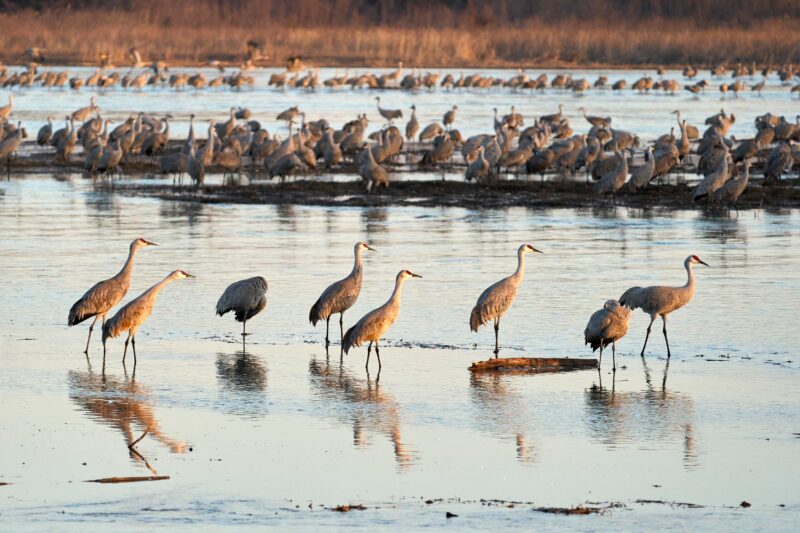
Last week, I explored how Nature’s transitions rarely happen overnight. Often, they’re more like an ongoing cycle as we see when our seasons change. Migration offers another rich lesson on Nature’s transitions. The famous sandhill cranes offer perhaps the best example of this powerful metaphor.
A masterclass in transition
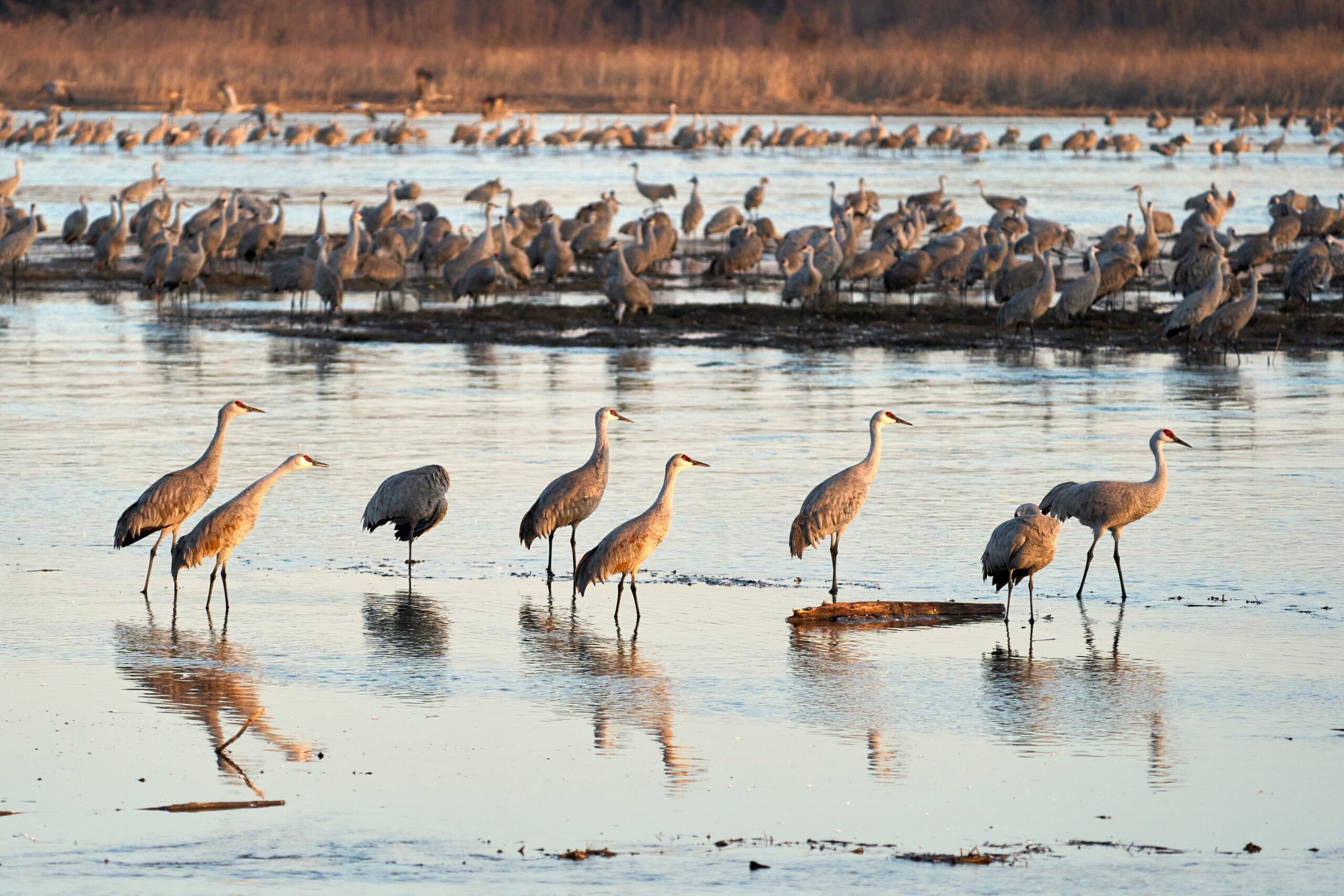
Sandhill cranes migrate more than 3,000 miles twice a year between Canada and Mexico. It doesn’t happen all at once, though, as they make this journey in several important stages. Along these biannual treks, the sandhill cranes stock up on nutrients for the long flight ahead. They have favorite resting spots along the way, where they might stay for up to three weeks, foraging for food before continuing the next leg of their journey. Nebraska is a well-known stop on this journey, where as many as 1,000,000 sandhill cranes—80% of the entire world’s population—feed in a small 75- to 80-mile stretch of the central Platte River Valley.
A larger purpose pulls these beautiful birds toward their destination. That purpose is the search for a better environment in which to spend their time in the season ahead. When I’m lucky enough to see the sandhill cranes, what always comes to mind is that although they have a clear destination in mind, they take their time getting there.
How can humans migrate with purpose?
We often have destinations in mind, but the path to get there isn’t always clear or well planned. That might be because we have to learn as we go.
Taking time to migrate toward a destination is part of the process. Just like the sandhill cranes, we need time to gather the knowledge, the nutrients, and the strength for the journey. We’ll recognize our destination when we get there.
Our careers are often like the sandhill crane migration. On reflection, we can see stages that aren’t always clear while living through them. There are seasons when we gather skills and experience without knowing where they are leading us. There are resting points—jobs or roles we stay in longer than expected—where we forage for what we need next. At each stage, we don’t know the final destination. We can only know the next leg of the journey.
That’s the part of migration we tend to forget. The sandhill cranes can’t see Mexico from Canada. They trust the process of migrating in stages, even if the whole path isn’t completely mapped out.
Separate the destination from the journey
One thing I tell my clients when they’re making a big decision is to separate the decision from the transition. We often combine the two, which can get us stuck. Worrying about the right plan can keep us from making a decision that could lead us to a wonderful new place—or purpose. At a minimum, our momentum forward can be stifled. Separating our destination from the journey helps us focus on the decision first. Once that’s clearer, we can move forward and start to map things out with a better sense of direction.
We’re free to explore what form that transition might take as we let go of what we no longer need. We can look to Nature’s own patterns of transition as we ask ourselves:
What’s the right pace for this migration?

Kathy, I so enjoy your posts every Saturday. Thank you so much for taking the time to share your gentle wisdom and thoughtful insights with us. Catharyn
A great reminder that the journey is important
Thank you