


This week guest blogger Dina Ely explains why the constant hunt for more isn’t making us safer, the concept of toxic abundance, and the powerful concept of enough.
For a long time, we’ve been told that abundance is the antidote to scarcity. We’ve been given messages like:
Think positively. Grow faster. Hit the next target. Expand, optimize, scale. Secure a little more.
Do all this and then we’ll feel safe, we’ve been told. Sadly, this isn’t working. Today leaders and organizations have more resources, tools, and data than ever before, yet people still feel perpetually on edge. Everyone worries about what happens if they run out of something they view as essential.
That’s not a search for abundance. That’s scarcity in disguise.
Scarcity, abundance and the space between
A scarcity mindset is the belief—often unconscious—that there isn’t enough time, money, safety, recognition, or opportunity. When we operate from a scarcity mindset, our nervous systems treat everyday life like an emergency. We compete, hoard, hustle, and control.
A traditional abundance mindset once meant something quite different from the above scenario. Abundance emphasized gratitude, possibility, and the belief that resources should be shared rather than fought over. But something has shifted in recent years. Lately, I’ve noticed a new version of this formerly generous concept. I call it toxic abundance.
What Is Toxic Abundance?
When abundance stops being about possibility and starts becoming an anxious strategy for control, it becomes toxic. When toxic abundance is present, “more” is the route to safety and accumulation is equated with security. Masquerading as the search for success, this new version uses constant growth, planning, and false positivity to avoid uncertainty.
Toxic abundance is scarcity with better branding.
The Seven Faces of Toxic Abundance
In my work, and in conversations with leaders, I see toxic abundance show up in seven remarkably consistent patterns:
1. Entitlement: “There’s enough, so I deserve my piece.” When we hear this, abundance typically has become about claiming, winning, or securing status rather than participating in shared sufficiency.
2. Control: “If I plan hard enough, optimize hard enough, manifest hard enough, it will come.” In this scenario, more becomes something we try to force rather than something we relate to wisely. We tell ourselves if we plan enough, optimize enough, or manifest hard enough, the desired goal will come.
3. Denial: Sometimes we use positive language to override reality. Uncertainty and tension are viewed as threats to be ignored rather than signals to be understood.
4. Hustle: This type of toxic abundance equates more output with more safety. In the search for constantly increasing productivity goals stack endlessly, and achievements are never fully integrated. When hustle abundance is present, rest feels dangerous and rarely rewarded.
5. Hoarding: Unfortunately, hoarding has become an epidemic, particularly in our society today. We see that when people hoard things like money or products. It also appears when leaders and staff hoard credentials, capacity, or even commitments. This “just in case” mindset doesn’t come from greed, but from fear.
6. Thought-policing: Sometimes we try to avoid negative thoughts or emotions because we believe this may manifest something unwanted. Unfortunately, this pattern can block important reflection and hinder emotional processing, both major components of inner resilience.
7. Bypass: Here we simply refuse what has failed, what hurt us, or what needs repair. Bypassing leaves the past unexamined, and we miss important lessons that are part of a continuous feedback cycle. As a result, the same problems quietly repeat.
How we get stuck in toxic abundance
I tell my clients that toxic abundance is a nervous system response to uncertainty, not a character flaw. The science of neurology teaches us that our brains contain certain mechanisms that unconsciously reinforce the patterns I’ve described above.
Human brains are designed to return to an emotional baseline. What once felt exciting or stabilizing quickly becomes normalized as part of what scientists call hedonic adaptation, or the “hedonic treadmill.” The treadmill effect happens when the novelty of a promotion wears off, and now we’re working at just another job. Organizationally, revenue milestones that once felt like crossing the finish line are now just something to be maintained. Relief transforms into anxiety as the target keeps moving.
Research on what’s called the “poverty burden” shows even brief experiences of financial insecurity can rewire the nervous system. Poverty, or fear of it, shrinks mental bandwidth and the brain begins to scan constantly for danger. When threat reactivity like this happens, more starts to feel like survival. In this scenario, toxic abundance is driven by protection even when on the surface it looks like greed.
Sometimes when abundance thinking becomes toxic, our inner lens keeps highlighting what is not yet here and we experience goal-filtered attention. What we aim for repeatedly becomes what we actually see. If our organizational goal is perpetual growth, for example, our perception reorganizes around where it is missing. Even inside success.
Over time, these patterns erode both people and organizations. When toxic abundance is present growth may occur but the team feels like it has lost the things that really matter like clarity, a sense of community, and even reality. Because we now live in a scenario that focuses on the “next” and the “now,” we lose our sense of presence. As people and systems are depleted, sustainability become impossible.
The path to true abundance
In healthy ecosystems, Nature doesn’t chase more for its own sake. Living systems respond to need, gather what is necessary, and rest after the need is met. A bee, for example, stops flying once its work for the day is done. It definitely doesn’t stay awake ruminating on what it has or hasn’t accomplished! No, that hardworking bee sleeps so it can be ready for the next day.
Living systems stabilize themselves through sufficiency, not excess. Enough is the way out of toxic abundance.
Enough doesn’t mean resignation, stagnation, or settling for less, but instead it’s the support we feel by remaining in the present. It’s the knowledge that personally or organizationally, there is enough for today.
Not forever.
Not for every imagined future.
For now.
The Enough Inventory
Enough is grounded in real, existing supports. For people, this goes beyond self-care and might include things like stable housing, supportive relationships, skill-building, and good health routines. Within organizations, enough is reflected in the team’s capacity, reliable systems and infrastructure, and institutional memory. When an organization is focused on enough, we see trust as the bedrock of its relationships, processes that work well, and a strong sense of shared purpose.
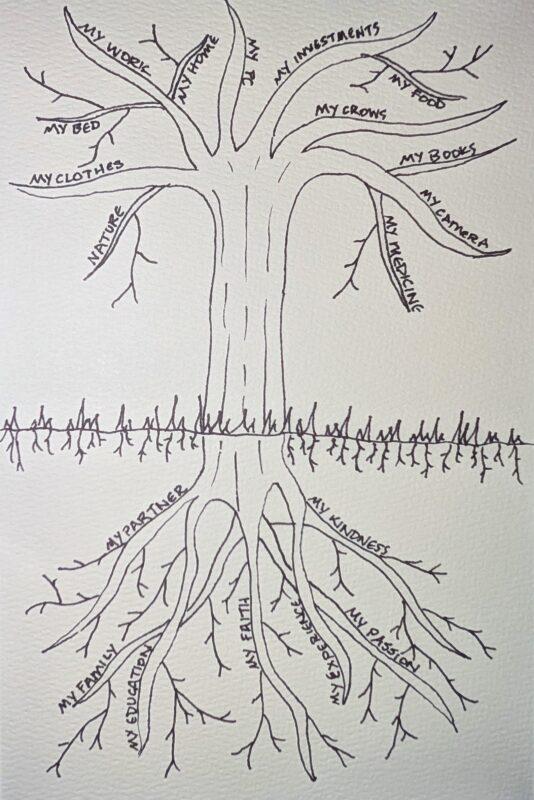
Within Nature, living systems meet the needs of the present season before “worrying” about the next. Enough helps remove toxic abundance patterns by stabilizing what’s there before chasing what comes next. There is a simple practice I’ve developed called the Enough Inventory. It’s inspired by the way trees are supported and held by both visible and invisible systems.
First, imagine a tree. Above ground are the branches, what is easy to see. Below ground are the roots, what invisibly holds everything in place. Now, think about your supports working much the same way. Now, imagine your visible supports as branches of the tree. This might be your income, your most trusted relationships, rituals or stable routines, and any other systems that you can “see.”
Next, think about the roots, or invisible supports. What is your skillset or experience? How does trust in other people and systems support you? How does your culture support you? Do you have a strong sense of purpose?
Now, once a day, name five branches and five roots you notice in your life today. If you like to draw, sketch a tree and note your visible and invisible supports.
Then write one sentence of gratitude.
This isn’t about pretending everything is fine. You’re literally training your nervous system to recognize safety in the present. Practiced daily, this simple reflection becomes an exercise in neuroplasticity. Mindful repetition harnesses neuroplasticity, building new neural pathways, reshaping the brain, and establishing strong beliefs and thought patterns. Adding gratitude invites openness, generosity, and appreciation into lived experience, key elements of positive psychology.
Leading from Enough
When we genuinely feel supported, we soften and sharing becomes natural. As leaders who feel secure knowing what is already there is enough, we make better choices based on a strong appreciation of sustainability, trust, and adaptability. We gain an openness that is crucial to organizational health. Eventually, it becomes easier to feel supported, noticing toxic abundance patterns before they become damaging.
Living systems don’t thrive by hoarding. They become sustainable as part of a bigger whole, and building resilience through sufficiency and sustaining life as a result. When leaders and organizations learn to recognize “enough,” they move out of chronic defense and into stewardship of people, resources, and purpose. That is when generosity, creativity, and resilience become possible again.
Not because there is more. Because there is—finally—enough.
If you’d like to explore more about “enough,” watch the recording of a recent Regenerative Leadership Conversation, “Finding Steady Ground Between Scarcity and Excess.”
About Dina Ely: Dina is a board-certified holistic health practitioner and ecotherapy innovator whose work integrates nature’s intelligence, psychology, neuroscience, and holistic well-being. She helps people cultivate grounded, regenerative ways of relating to themselves, their work, and the living world. To learn more about Dina’s work, visit WhisperingWilds.com and read her reflections on Substack.